Native vs Cross-Platform Apps: Which Should Your Business Choose?
Should your app be built natively for iOS and Android, or with a cross-platform framework like Flutter or React Native? A clear comparison to help you decide.
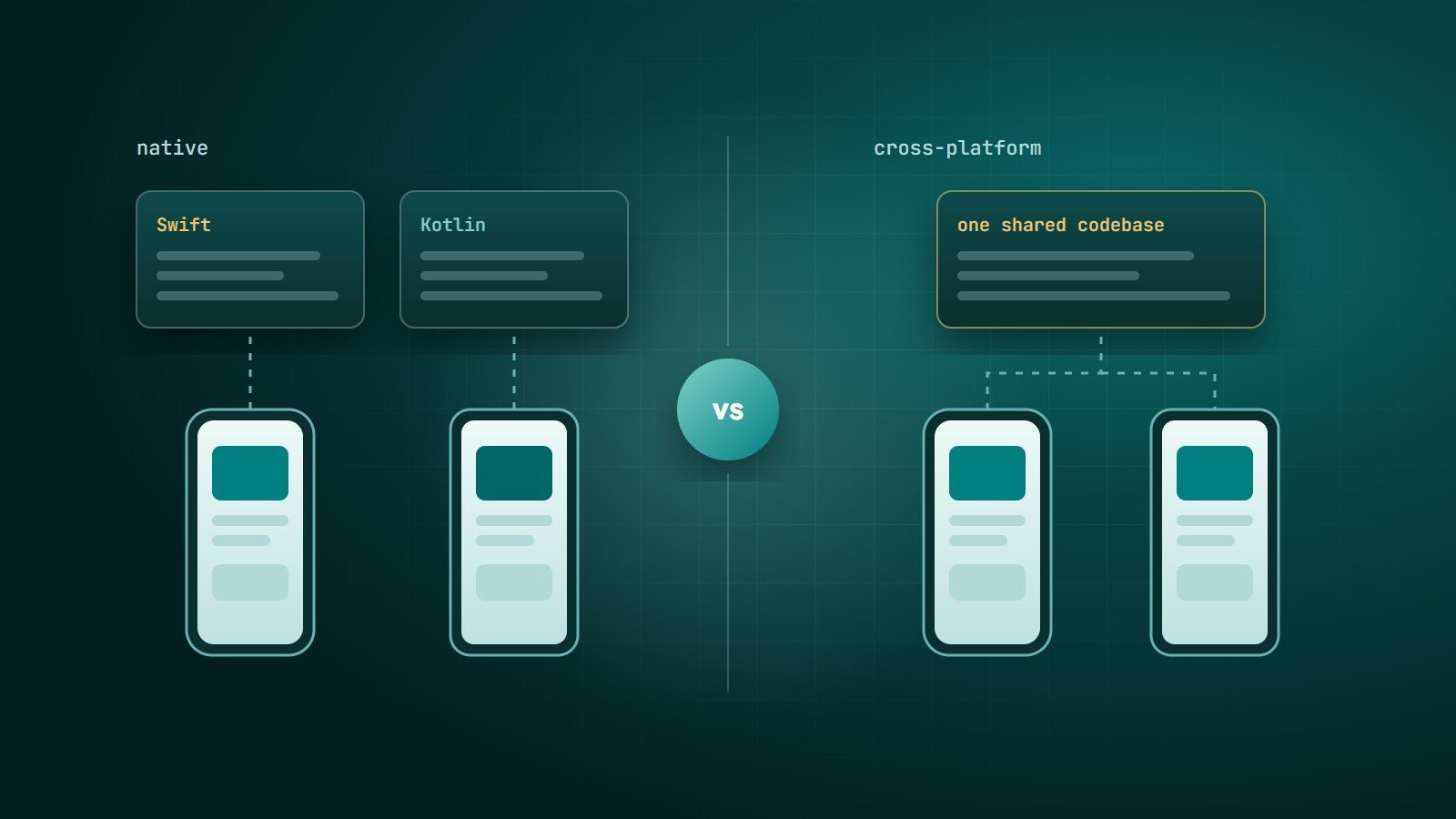
One of the first technical decisions in any mobile app project is how to build it: natively, with a separate app for iOS and Android, or cross-platform, with one shared codebase that runs on both. The choice affects your budget, your timeline and how the app feels to users.
There is no answer that is right for every app. This guide explains the trade-offs so you can make the decision with confidence.
What "native" means
A native app is built with each platform's own languages and tools:
- iOS: Swift, usually with SwiftUI or UIKit, built in Xcode.
- Android: Kotlin, usually with Jetpack Compose, built in Android Studio.
You get direct access to every platform feature as soon as Apple or Google releases it, and the app follows each platform's conventions naturally. The cost is that you maintain two separate codebases, which usually means more development and testing effort.
What "cross-platform" means
Cross-platform frameworks let you write most of the app once and run it on both iOS and Android. The most widely used options are:
- Flutter — created by Google, uses the Dart language and draws its own interface, which makes the app look consistent on every device.
- React Native — created by Meta, uses JavaScript or TypeScript and renders native interface components; a natural fit for teams that already use React on the web.
- Kotlin Multiplatform — shares business logic written in Kotlin, while the interface can stay native or be shared as well.
Platform-specific code is still possible where needed — for example, for a particular hardware feature.
Side-by-side comparison
| Factor | Native | Cross-platform |
|---|---|---|
| Codebases | Two (iOS and Android) | Mostly one shared codebase |
| Development cost and time | Usually higher | Usually lower for the same features |
| Performance | Best possible, especially for graphics-heavy or very complex apps | Excellent for most business apps |
| Access to new platform features | Immediate | Sometimes needs a plugin or custom native code |
| Consistency between iOS and Android | Features can drift apart | Features stay in sync by default |
| Maintenance | Two apps to update and test | One main codebase to update |
When native is the better choice
- The app depends heavily on advanced device features — complex camera processing, augmented reality, Bluetooth hardware, background processing.
- Performance is the product — high-end games, video editing, real-time graphics.
- You only need one platform for now.
- You have, or plan to build, separate dedicated iOS and Android teams.
When cross-platform is the better choice
- You need both iOS and Android, and want to launch them together.
- The app is a typical business app: accounts, content, bookings, e-commerce, dashboards, chat, notifications.
- You want to control budget and time-to-market, especially for an MVP.
- You want one team to maintain the app and keep features identical on both platforms.
Common myths
- "Cross-platform apps always feel slow." Modern frameworks produce smooth, responsive apps for the vast majority of business use cases. Poor performance is far more often caused by poor implementation than by the framework.
- "Native is always more expensive." For a single-platform app, native can be just as efficient.
- "You can never switch later." Switching means rewriting the interface, but a well-designed backend and API can be reused whichever way you go.
Questions to ask before deciding
- Do we need both iOS and Android at launch?
- Which device features does the app depend on?
- How important is identical behaviour on both platforms?
- Who will maintain the app after launch?
- What is our budget and target launch date?
Key takeaways
- Native gives maximum performance and immediate access to platform features, at the cost of two codebases.
- Cross-platform (Flutter, React Native, Kotlin Multiplatform) shares one codebase and is an excellent fit for most business apps.
- Decide based on your features, platforms, budget and long-term maintenance — not on trends.
How Wintecsys can help
We help you choose the right approach for your app before any code is written, then design, build and publish it for iOS and Android — native or cross-platform, with the backend and admin panel included.