Edge Computing Explained: Why Processing Is Moving Closer to Users
Edge computing moves processing closer to where data is created — near users and devices — instead of sending everything to distant data centres. Here is why it matters.
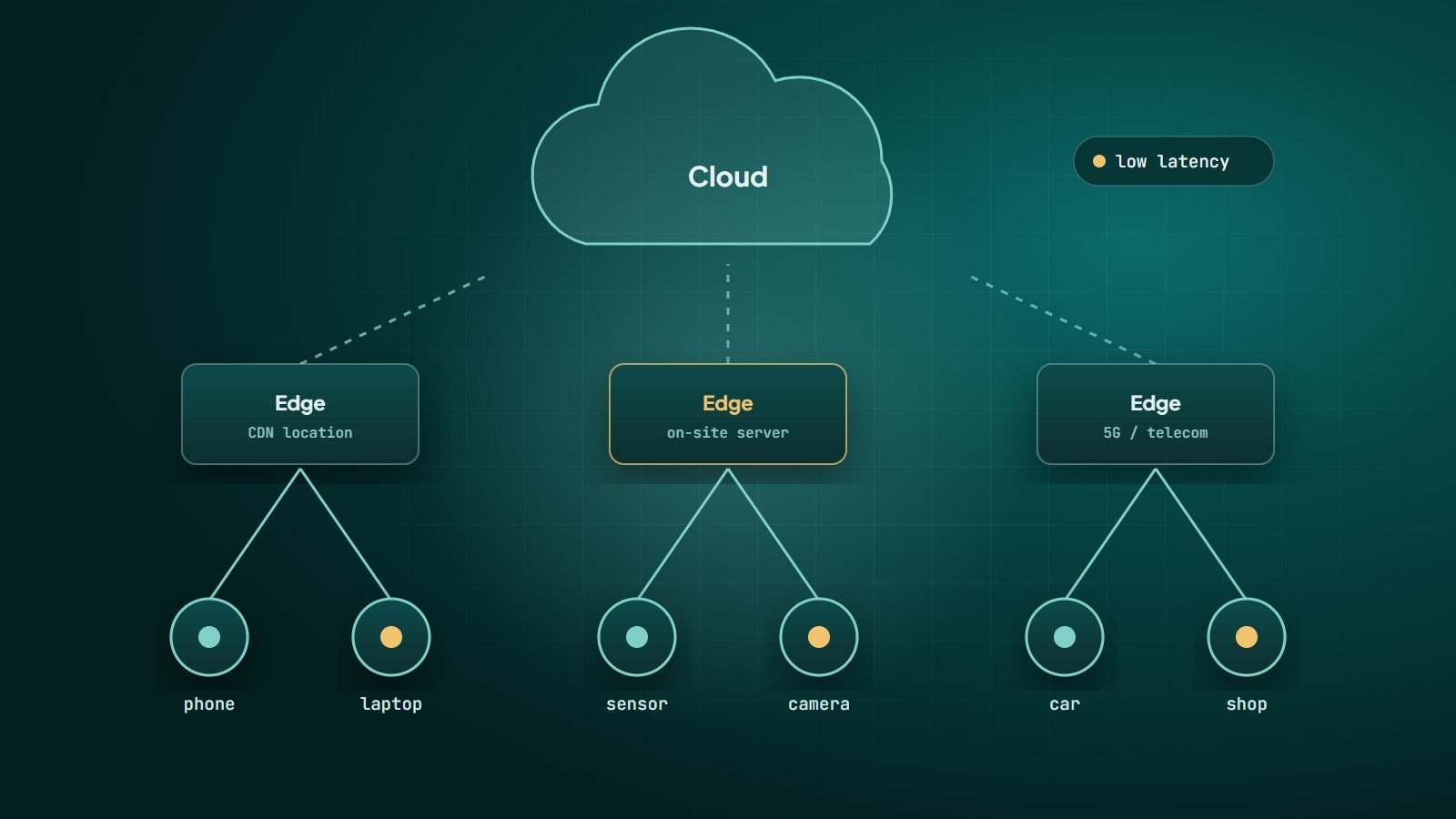
Cloud computing centralised processing in large data centres. That model is powerful, but distance has a cost: data must travel to the data centre and back, adding delay, using bandwidth and sometimes moving sensitive information further than necessary. Edge computing addresses this by processing data closer to where it is created or used.
What "the edge" means
"Edge" describes any location between the central cloud and the end user where computing can happen:
- Device edge — on the device itself: a phone, a camera, a car, a factory sensor.
- On-premises edge — a small server in a shop, factory, hospital or office.
- Network edge — servers in content delivery network (CDN) locations or telecom facilities, physically close to users.
Edge vs cloud
| Central cloud | Edge | |
|---|---|---|
| Location | A few large regions | Many locations near users or devices |
| Latency | Depends on distance to the region | Low — fewer network hops |
| Compute power | Practically unlimited | Limited per location |
| Best for | Heavy processing, storage, analytics, training AI models | Real-time responses, filtering data, local autonomy |
Edge computing does not replace the cloud. Most edge architectures are hybrid: quick decisions happen at the edge, while long-term storage, analysis and management stay in the cloud. If you are new to the cloud side, see how cloud computing works.
Where edge computing is used
- Websites and APIs — CDNs cache content near users; edge functions (such as Cloudflare Workers, AWS Lambda@Edge and CloudFront Functions, Vercel and Netlify edge functions) run code in CDN locations for personalisation, redirects, authentication checks and A/B tests.
- Internet of Things — factories, energy grids and smart buildings process sensor data locally and send only summaries or anomalies to the cloud.
- Video analytics — cameras analyse footage locally instead of streaming everything.
- Retail — in-store systems that keep working even when the internet connection drops.
- Vehicles and robotics — decisions that cannot wait for a round trip to a data centre.
- On-device AI — phones and laptops increasingly include dedicated AI accelerators that run models locally for speed and privacy.
Benefits
- Lower latency — faster responses for users and real-time systems.
- Less bandwidth — filter and summarise data before sending it.
- Resilience — local operation continues when connectivity is lost.
- Privacy and data residency — sensitive data can be processed and kept locally.
Challenges
- Management at scale — deploying, updating and monitoring software across many locations is harder than in one data centre.
- Security — more devices and locations mean a larger attack surface, including physical access.
- Limited resources — edge environments have less compute, memory and storage, and edge function platforms impose runtime limits.
- Data consistency — keeping data synchronised between edge and cloud requires careful design.
Does your project need it?
For most business websites and applications, the practical form of edge computing is simple: put your site behind a CDN, cache static files at the edge and, where it helps, move small pieces of logic into edge functions. Full edge architectures make sense when you have devices generating large volumes of data, real-time requirements, unreliable connectivity, or strict data-locality rules.
Key takeaways
- Edge computing processes data close to users and devices; the cloud remains the central brain.
- It reduces latency and bandwidth, improves resilience and can help privacy.
- It adds management, security and consistency challenges.
- For most web projects, a CDN plus edge functions delivers the main benefits.
How Wintecsys can help
We design and deploy fast, resilient architectures — CDNs, edge functions and cloud back ends — so your website or application performs well for users wherever they are.