AI vs Machine Learning vs Deep Learning vs Generative AI: The Differences Explained
AI, machine learning, deep learning and generative AI are often used as if they mean the same thing. They don't. Here is how they fit together, with simple examples.
"AI" appears in almost every product announcement, often next to "machine learning", "deep learning" and "generative AI". These terms are related, but they are not interchangeable. Understanding the difference helps you judge claims, talk to technical teams and choose the right approach for a problem.
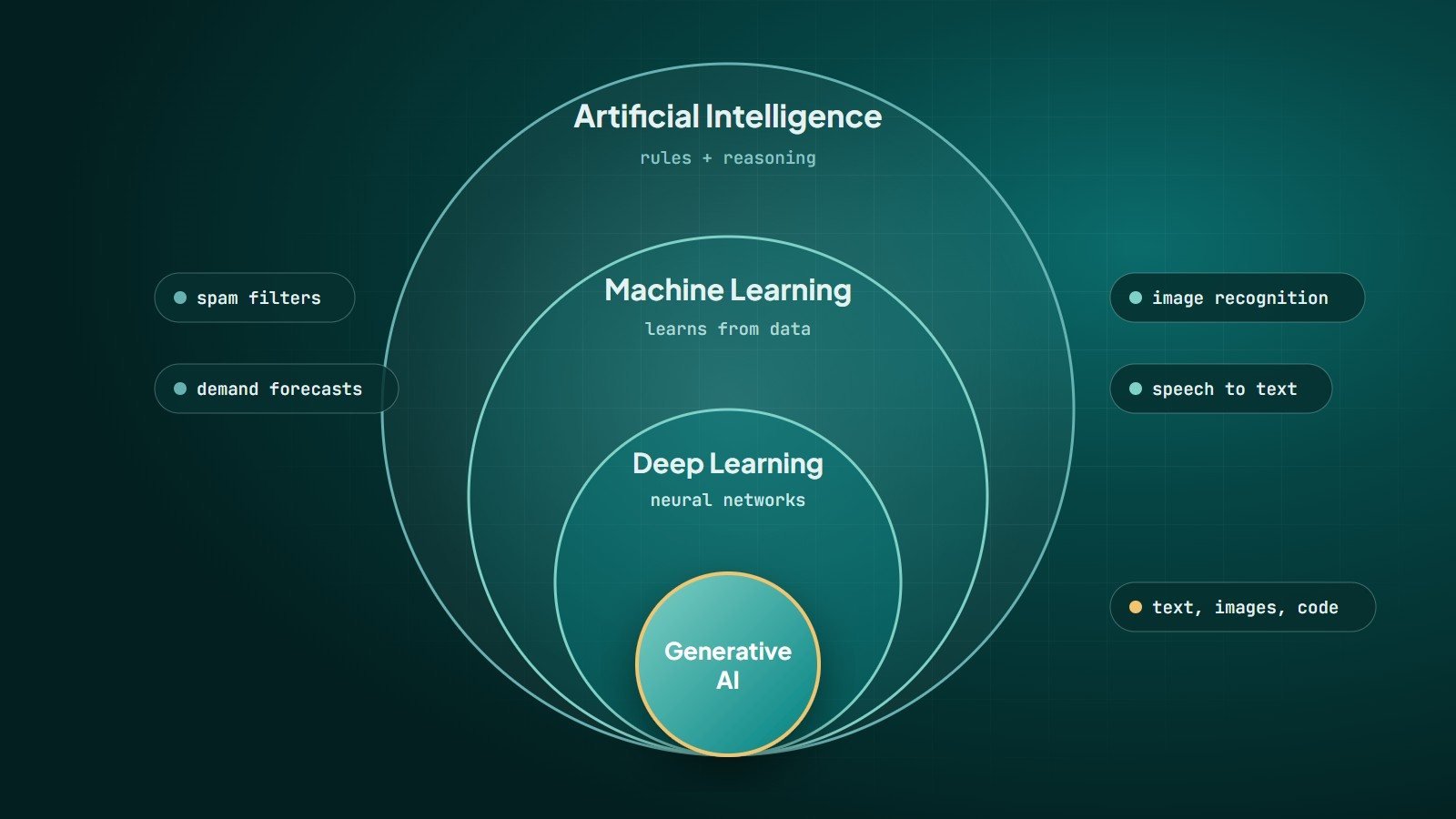
The big picture: nested circles
The easiest way to picture it is as circles inside circles:
- Artificial intelligence (AI) — the broadest field: making computers perform tasks that normally require human intelligence.
- Machine learning (ML) — a subset of AI where systems learn patterns from data instead of following only hand-written rules.
- Deep learning (DL) — a subset of ML that uses large neural networks with many layers.
- Generative AI — models, mostly built with deep learning, that create new content: text, images, audio, video or code.
Artificial intelligence
AI as a field dates back to the 1950s. Early AI was largely rule-based: experts wrote explicit rules ("if the temperature is above X and the pressure is below Y, then…"). Rule-based systems are still useful when rules are clear and stable — for example, validating forms or applying business policies. Their weakness is that real-world problems often have too many exceptions to write down.
Machine learning
Instead of writing the rules, you give the system examples and let it find the patterns. The main types are:
- Supervised learning — learning from labelled examples. Given thousands of emails marked "spam" or "not spam", the model learns to classify new emails. Other examples: predicting house prices, forecasting demand, detecting fraudulent transactions.
- Unsupervised learning — finding structure in unlabelled data, such as grouping customers into segments with similar behaviour.
- Reinforcement learning — learning by trial and error with rewards, used in robotics, games and to refine language models' behaviour.
Classic ML algorithms — linear and logistic regression, decision trees, random forests, gradient boosting — remain excellent for structured, tabular data like sales records or sensor readings. They are often faster, cheaper and easier to explain than deep learning.
Deep learning
Deep learning uses artificial neural networks with many layers. Each layer learns progressively more abstract features — in an image, from edges to shapes to objects. Deep learning made major progress possible in:
- Computer vision — recognising objects, reading documents, medical imaging.
- Speech — speech recognition and text-to-speech.
- Language — translation, summarisation and understanding text.
Its cost: deep learning typically needs large amounts of data and significant computing power (usually GPUs), and its decisions are harder to explain.
Generative AI
Generative AI models learn the patterns of their training data so well that they can produce new, similar content. The main families are:
- Large language models (LLMs) — based on the Transformer architecture introduced in 2017. They generate text by repeatedly predicting the next token (a word or part of a word). They power chat assistants, writing tools and coding assistants.
- Image and video generators — most current systems use diffusion models, which learn to turn random noise into an image step by step, guided by a text prompt.
Generative AI is powerful and flexible, but it can produce plausible-sounding errors, and its outputs need review when accuracy matters.
Which one fits your problem?
| Problem | Usually the right approach |
|---|---|
| Clear, stable rules (e.g. discount eligibility) | Plain code — no AI needed |
| Predict a number or category from business data (churn, demand, fraud) | Classic machine learning |
| Understand images, audio or scanned documents | Deep learning (often a pre-trained model) |
| Answer questions, summarise, draft or extract from text | Generative AI / LLMs, ideally grounded in your data |
Good engineering starts with the problem, not the buzzword. Sometimes the best "AI" solution is a well-designed rule.
Key takeaways
- AI is the field; machine learning learns from data; deep learning uses many-layered neural networks; generative AI creates new content.
- Classic ML is often best for structured business data.
- Deep learning excels with images, audio and language.
- Generative AI is flexible but needs grounding and review where accuracy matters.
How Wintecsys can help
We help businesses pick the right approach — from simple automation to machine learning and generative AI — and build it into their software. We start from your problem and your data, and we will tell you if AI is not needed.