What Is Retrieval-Augmented Generation (RAG)? A Clear Explanation
Retrieval-augmented generation lets a language model answer questions using your own documents. Here is how RAG works, step by step, and what makes it succeed or fail.
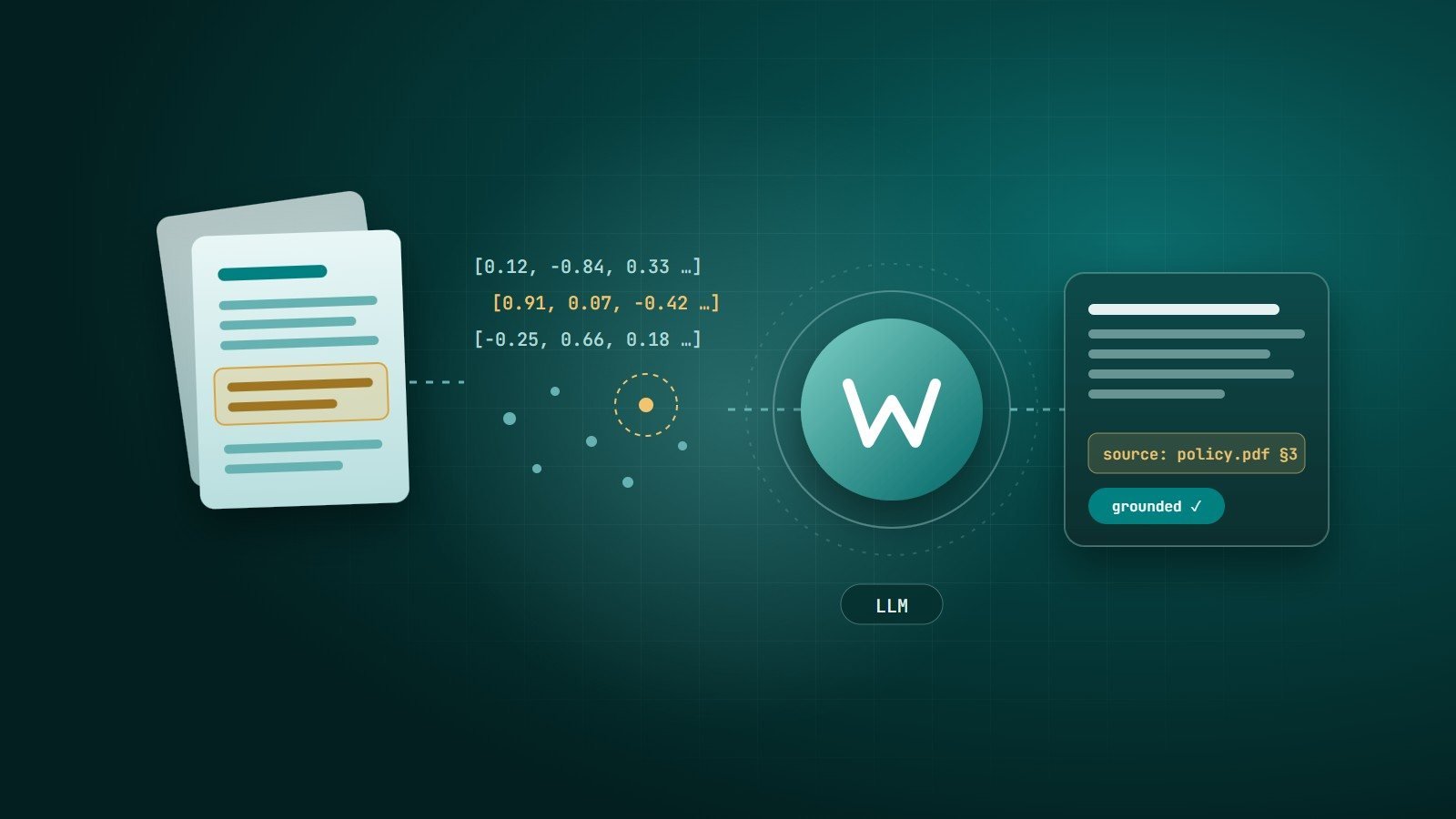
Large language models (LLMs) are good at writing fluent text, but they only know what was in their training data, and they can produce confident answers that are wrong. Retrieval-augmented generation (RAG) addresses both problems by fetching relevant information from your own sources and giving it to the model as part of the prompt.
Instead of asking the model "what do you know about our refund policy?", a RAG system first finds the paragraphs of your policy document that discuss refunds, then asks the model to answer using those paragraphs.
Why RAG is useful
- Up-to-date and private knowledge. The model can work with documents it was never trained on — internal wikis, product manuals, support tickets — without retraining.
- Grounded answers. Because the answer is based on retrieved text, the system can show its sources so people can check them.
- Easier updates. Changing what the system knows means updating documents, not training a model.
How a RAG pipeline works
A typical system has two phases: preparing the knowledge (indexing) and answering questions (retrieval and generation).
1. Indexing your documents
- Load documents from their sources — files, web pages, databases.
- Split them into chunks, for example a few hundred words each, ideally along natural boundaries like headings and paragraphs.
- Embed each chunk: an embedding model converts text into a vector — a list of numbers — such that texts with similar meaning end up close together.
- Store the vectors, with the original text and metadata such as source and date, in a vector index or a database with vector search.
2. Answering a question
- Embed the question with the same embedding model.
- Retrieve the chunks whose vectors are most similar to the question's vector.
- Build the prompt: instructions, the retrieved chunks, and the user's question.
- Generate: the LLM writes an answer based on the provided context, ideally citing which chunks it used.
Question ──► embed ──► search index ──► top-k chunks
                                            │
             instructions + chunks + question ──► LLM ──► answer + sources
What makes RAG work well
Most of the quality of a RAG system is decided before the model writes a single word. If the right information is not retrieved, the model cannot use it.
| Factor | What to consider |
|---|---|
| Chunking | Chunks that are too small lose context; chunks that are too large dilute relevance. Keeping headings with their content helps. |
| Hybrid search | Combining vector similarity with keyword search catches exact terms — product codes, error messages, names — that embeddings can miss. |
| Re-ranking | A second, more precise model can re-order the top results so the most relevant chunks go into the prompt. |
| Metadata filters | Filtering by product, language, permission or date keeps irrelevant or out-of-date content out. |
| Prompt instructions | Tell the model to answer only from the provided context and to say when the context does not contain the answer. |
Common failure modes
- Retrieval misses: the answer exists, but the question is phrased differently from the document. Hybrid search and query rewriting help.
- Conflicting or stale documents: two versions of a policy are both retrieved. Curating sources and using date metadata matters.
- Answers beyond the context: the model fills gaps with general knowledge. Clear instructions and showing sources reduce this, but do not eliminate it entirely.
- Access control leaks: if the index contains documents a user should not see, retrieval can surface them. Apply permissions at retrieval time.
RAG or fine-tuning?
RAG and fine-tuning solve different problems. RAG gives a model access to knowledge that changes or is private. Fine-tuning adjusts a model's behaviour — style, format, or a specialised task. Many production systems start with RAG because it is easier to update and to audit, and add fine-tuning only when there is a clear behavioural need.
How to evaluate a RAG system
Build a set of realistic questions with known correct answers and sources. Then measure separately:
- Retrieval quality: was the right chunk among the retrieved results?
- Answer faithfulness: is the answer supported by the retrieved text?
- Answer usefulness: does it actually answer the question?
Measuring the stages separately tells you whether to improve the search or the generation step.
Key takeaways
- RAG retrieves relevant passages from your data and gives them to the model as context.
- Retrieval quality — chunking, hybrid search, re-ranking, filters — drives answer quality.
- Show sources, enforce permissions at retrieval time, and evaluate retrieval and generation separately.
How Wintecsys can help
We build AI assistants and chatbots that answer from your own content — product information, policies, manuals or internal documents — using the retrieval techniques described above, with sources shown and access rules respected. We can add them to your website, your customer-support channels or your internal tools.
See our AI and automation services or tell us about your project.