WordPress vs a Custom-Built Website: Which Is Right for Your Business?
WordPress powers a large share of the web, but it is not the right answer for every project. Here is an honest comparison with a custom-built website — and how to decide.
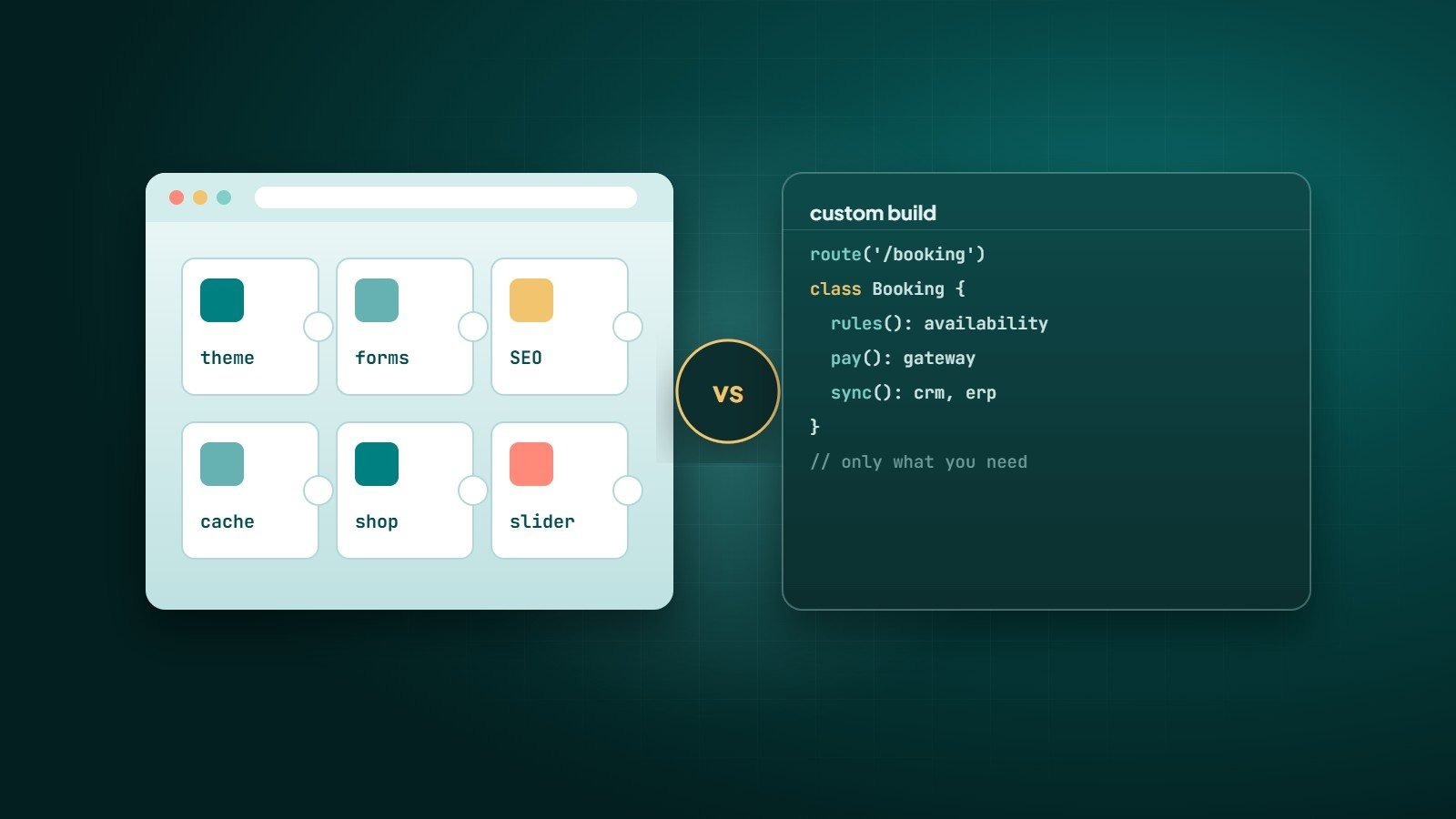
One of the first decisions in any website project is the platform. For most businesses the choice comes down to two paths: WordPress, the most widely used content management system, or a custom-built website developed specifically for your needs. Both are legitimate. The right one depends on what the website has to do.
What we mean by each option
WordPress is open-source software that provides a ready-made admin panel, a theme system for design and a very large ecosystem of plugins for features like forms, SEO, e-commerce (WooCommerce) and multilingual content.
A custom website is built with a programming language or framework — for example PHP with Laravel, JavaScript with Next.js, or Python with Django — with only the features you need, and an admin panel designed around your content and workflow.
Side-by-side comparison
| Factor | WordPress | Custom-built |
|---|---|---|
| Initial cost | Usually lower for standard sites | Usually higher; you pay for design and development of each feature |
| Time to launch | Fast for content sites | Longer, depends on scope |
| Editing content | Familiar editor, many tutorials | Admin designed for your exact content |
| Flexibility | Very high through plugins, within the platform's model | Unlimited — anything can be built |
| Performance | Good when well built; often slowed by heavy themes and plugins | Can be very lean, because nothing unused is loaded |
| Security | Core is well maintained; most risk comes from outdated or poorly written plugins and themes | Smaller attack surface, but depends entirely on the developer's quality |
| Maintenance | Frequent core, theme and plugin updates | Fewer updates, but you rely on developers for changes |
| Vendor independence | Many developers know WordPress | Requires clean code and documentation so others can take over |
When WordPress is the right choice
- A company website, portfolio or blog where content is the main product.
- A limited budget and a need to launch quickly.
- Your team wants to publish and edit frequently using a well-known editor.
- Standard features — contact forms, a blog, a simple shop — are enough.
The key to a good WordPress site is restraint: a lightweight, well-coded theme, few carefully chosen plugins, automatic backups and a plan for updates.
When a custom build is the right choice
- The website contains real business logic: bookings with complex rules, quotes, customer portals, dashboards, marketplaces.
- It must integrate deeply with your own systems — ERP, CRM, inventory, internal APIs.
- Performance and security requirements are strict.
- You are building a product, not just a website, and expect it to grow into a web application or have a mobile app later.
- You keep fighting plugin conflicts and limitations on your current site.
The middle paths
- WordPress with custom development — a custom theme and a few custom plugins built for your needs, instead of piling up third-party plugins.
- Headless CMS — content is managed in a CMS (WordPress or a dedicated headless CMS) and displayed by a custom front end. This combines easy editing with full design and performance control, at a higher development cost.
Questions to ask before deciding
- What must the website do, beyond showing information?
- Which systems must it connect to?
- Who will edit it, and how often?
- How important are speed and security for your business?
- Where do you expect the site to be in two or three years?
Key takeaways
- WordPress is excellent for content-driven sites with standard features and tight timelines.
- A custom build pays off when the website contains business logic, deep integrations or strict performance and security needs.
- Whichever you choose, the quality of the implementation matters more than the platform.
How Wintecsys can help
We build both — well-structured WordPress sites and custom websites and web applications — and we will recommend the option that fits your goals and budget, not the one that is easiest for us. See also what drives the cost of a website.